
Polyaspartic vs Epoxy for Fargo Garage Floors
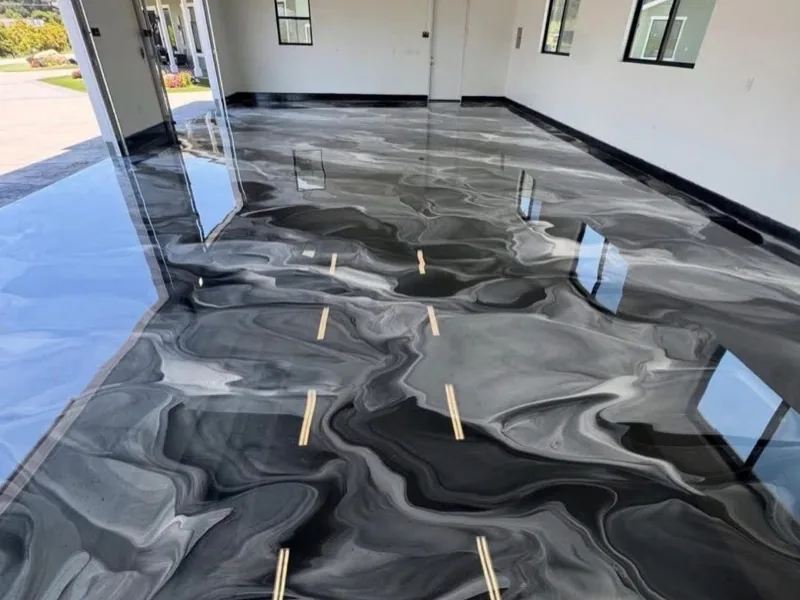
Quick answer: Epoxy gives strong adhesion and thickness at lower cost; polyaspartic cures faster, resists UV yellowing, and often tolerates a wider temperature range, at a higher price. Many Fargo garages use epoxy for the base and a polyaspartic topcoat. Call (701) 815-5240 for a recommendation for your floor.
If you have started shopping for a garage floor coating, you have probably noticed two names: epoxy and polyaspartic. Contractors sometimes present them as rivals, but they are better understood as tools that do different jobs. This guide explains the differences in plain language and shows how they are combined in a cold climate like Fargo's.
What they are
Epoxy is a two-part thermosetting resin that cures into a hard, thick, well-bonded film. It adheres very well to properly prepared concrete, is relatively economical, and forms the backbone of most flake and metallic systems. Its main weaknesses are sensitivity to UV exposure, which can cause amber yellowing over time, and slower cure times.
Polyaspartic is a type of polyurea chemistry. It cures quickly, can be formulated for strong UV stability, and produces a hard, abrasion-resistant film. It is typically more expensive than epoxy, can be less forgiving to apply because of its short working time, and is often used as a topcoat rather than as a full thick-build system.
Side-by-side comparison
| Factor | Epoxy | Polyaspartic |
|---|---|---|
| --- | --- | --- |
| Cure and return to service | Slower; commonly a day or more before light traffic | Faster; often hours to a day depending on product |
| UV stability | Can yellow in sunlight | Generally UV-stable |
| Working time | Longer, more forgiving | Short, requires skill and speed |
| Temperature window | Datasheet minimums often in the 40s to 50s °F for slab | Often tolerates a wider range; check the datasheet |
| Adhesion to prepared concrete | Excellent | Good to excellent |
| Abrasion resistance | Good | Very good |
| Cost | Lower | Higher |
| Typical use | Base coats, build coats, flake systems | Topcoats, fast-turnaround jobs |
Why cold weather matters in Fargo
Fargo-area garages face a unique problem: for much of the year, the slab temperature is too low for many products. Epoxy datasheets commonly set minimum slab and air temperatures, and curing slows dramatically in the cold. Polyaspartic products are often formulated for a wider temperature range and cure faster, which can be a real advantage when the window is short. Even so, "works in the cold" has limits, and every product has its own datasheet. If the garage can be heated and the slab brought into range, either can be installed in winter. If not, a warm window is wiser. Our cold climate guide goes deeper.
The hybrid approach
The most common professional garage system pairs both: an epoxy base for adhesion and build, a flake broadcast for color and texture, and a polyaspartic topcoat for hardness, UV stability and chemical resistance. You get the proven bond of epoxy and the clarity and speed of polyaspartic, at a cost between an all-epoxy and an all-polyaspartic system.
When to lean toward each
Epoxy topcoat makes sense when: - The garage is interior, with little sunlight - Budget matters - Longer cure time is acceptable - You want a forgiving, time-tested system
Polyaspartic topcoat makes sense when: - Large windows or open doors let in strong sun - You need a faster return to service - The floor will see heavy wear or chemicals - You want the clearest, least-yellowing finish
Myths to ignore
- *"Polyaspartic never fails."* Poor preparation still causes failure.
- *"Epoxy is outdated."* It remains the base of most durable systems.
- *"One coat of either will do everything."* Thickness and layering still matter.
Cost and next steps
Polyaspartic topcoats cost more than standard epoxy topcoats. See the cost guide for factors and labeled national ranges. To see how these coatings are used in flake floors, read flake epoxy floors. For a recommendation based on your garage, call or text (701) 815-5240.
Questions to ask a contractor offering polyaspartic
Because polyaspartic has a short working time and is less forgiving of mistakes, ask who will install it and how many such floors they have done. Ask what temperature range the specific product allows, whether the base coat is epoxy or something else, and how joints and cracks are treated before the topcoat. Ask what the cure schedule is for foot traffic and for vehicles. A good answer is specific; a vague one is a warning sign.
Frequently Asked Questions
Is polyaspartic better than epoxy?
Different, not simply better. Polyaspartic cures faster and resists UV; epoxy bonds well and costs less. Many floors use both.
Can polyaspartic be installed in winter?
Often at lower temperatures than epoxy, but every product has a minimum. We check slab temperature before committing.
Will epoxy yellow?
Epoxy exposed to strong sunlight can amber over time. A UV-stable topcoat reduces that.
How soon can I drive on a polyaspartic floor?
Product-dependent; many return to service sooner than epoxy. We give timing at the estimate.