Commercial Epoxy Flooring in Fargo, ND
Quick answer: Commercial epoxy flooring seals worn concrete in shops, warehouses, restaurants, retail floors and service bays so it resists traffic, chemicals and moisture and is easier to clean. Fargo Epoxy installs commercial coatings across the Fargo–Moorhead area and schedules around business hours. Call (701) 815-5240 for a free site visit.
Commercial floors do hard work. A concrete slab in a shop, warehouse, restaurant kitchen or showroom takes rolling loads, chemical spills, constant foot traffic and daily cleaning, and in North Dakota and Minnesota it also takes winter. Boots track in salt and sand, entry doors let in slush, and heated buildings keep the slab cycling through temperature and humidity swings. Uncoated concrete dusts, stains and absorbs liquids, which makes it hard to keep clean and, in some environments, hard to keep compliant with sanitation expectations.
Fargo Epoxy installs commercial epoxy flooring for businesses throughout the Fargo–Moorhead metro. This page explains what commercial coatings do, which types of spaces they suit, and how we plan an install so your business can keep operating.
Where commercial epoxy makes sense
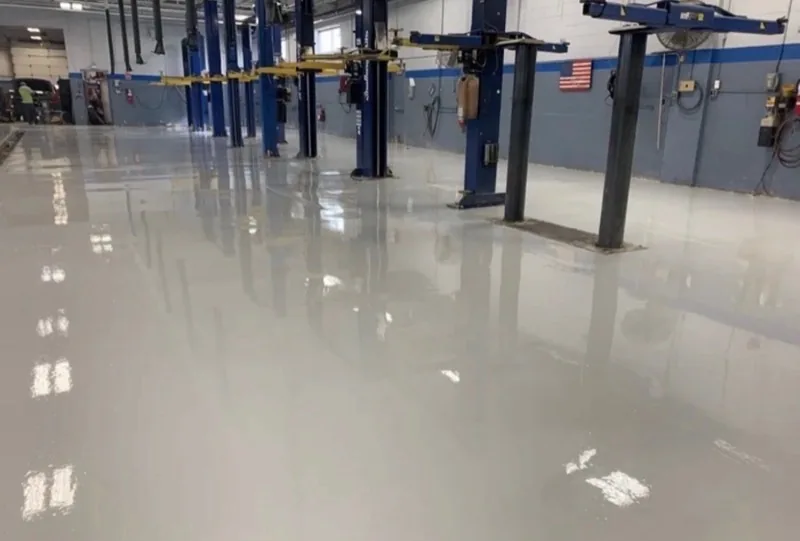
- Shops and service bays. Resistance to oil, brake fluid, coolant and hot tires, plus a bright surface that improves visibility.
- Warehouses and light industrial space. Dust control and a sealed surface that is easier to sweep and scrub.
- Restaurants, breweries and food service back-of-house. Seamless, cleanable floors with fewer places for grime to collect.
- Retail and showrooms. Flake or metallic systems that look good and stand up to customer traffic.
- Fitness and recreation spaces. Durable floors that resist wear from equipment.
- Offices and workshops with exposed slabs. A finished look with a sealed, dust-free surface.
Choosing the right system for a commercial slab
There is no single best commercial floor. The right system depends on what rolls across it, what spills on it and how it is cleaned. Considerations include:
- Traffic type. Foot traffic, pallet jacks and forklifts all call for different thicknesses and topcoat hardness.
- Chemical exposure. Some topcoats resist fuels and solvents better than others, and some environments need specific resistance.
- Slip resistance. Entrances, kitchens and wash areas can benefit from texture added to the topcoat.
- Light reflectance. Lighter colors improve brightness in warehouses and shops.
- Cure time. Businesses that cannot close for long may prefer a fast-curing topcoat. See polyaspartic vs epoxy for why cure speed differs between product families.
- Moisture. Slabs on grade without an effective vapor barrier can transmit moisture, which affects coating choice. We look at this before quoting.
Preparation for commercial floors
Commercial slabs are often older, oil-soaked or covered with previous coatings. Mechanical preparation is the starting point: diamond grinding for most floors and, on larger or heavily contaminated areas, shot blasting or other methods. We identify patches, cracks, control joints and cold joints, and decide how each should be treated. Joint movement is real in the Red River Valley climate, and a floor that ignores it will crack along the joints. Our prep and warranty page explains our general prep standards.
Scheduling around your business
Many commercial customers cannot take a whole space out of service for days. That is a normal planning issue, and we address it up front: work in phases or sections, schedule after hours or on weekends when possible, and set clear expectations for foot and vehicle traffic. The cure period is not negotiable, so we agree on when each section returns to use before the first day starts. In a Fargo winter, we also plan around building heat; the space must stay within the product's temperature range during install and cure.
What commercial customers should ask any contractor
- Is mechanical surface preparation included for the entire floor?
- What system thickness and topcoat are specified for the traffic and chemicals?
- How are cracks and joints treated?
- What is the return-to-service timeline for foot traffic and wheeled loads?
- What does the written warranty cover, and what is excluded?
We answer all of these in writing on the quote so you can compare bids on equal terms.
Free site visits
Commercial estimates start with a free on-site visit. Call or text (701) 815-5240, or send the quote form with the type of space and approximate size. If your project is a residential garage or shop, the garage floor page is the better fit.
Where commercial coatings earn their keep around Fargo
Commercial floors in the Fargo–Moorhead area face the same salt and meltwater as garages, plus their own daily abuse. These are the spaces where a coated floor tends to pay off, and what usually changes in the spec:
- Auto service bays and fleet shops: oil, coolant and brake fluid plus heavy rolling loads call for thicker builds and a chemical-resistant topcoat.
- Agricultural shops and equipment storage: big machinery, mud and winter wash-down call for durable, textured systems that are easy to hose off.
- Restaurants and commercial kitchens: constant wet cleaning and grease call for slip-resistant texture and, often, a coved base so water cannot sit at the wall.
- Kennels, grooming and vet spaces: seamless, sanitary surfaces that stand up to repeated disinfecting.
- Warehouses, retail and showrooms: forklift or cart traffic and appearance both matter, so we balance film thickness with finish.
- Gyms, schools and churches: high foot traffic, easy cleaning and a slip-resistant texture at entries.
Quartz broadcast systems give more grip than vinyl flake and are common in commercial wet areas. We plan phases around your business hours so part of the building can stay open.
Frequently Asked Questions
Do you coat floors in occupied buildings?
Often, in phases or after hours. We plan the sequence with you so each section has its cure time.
Can epoxy handle forklift traffic?
Properly specified systems can, but the system type and thickness have to match the loads. We discuss traffic during the site visit.
How do you handle slab moisture in commercial buildings?
We discuss moisture history with you and look for signs on site. A coating cannot stop active moisture problems, so we are upfront if the slab needs attention first.
Can you work in winter?
When the building can be kept in the product's temperature range, yes. We confirm the conditions before scheduling.
What floor coating is best for a commercial kitchen or wash-down area?
Usually a seamless, slip-resistant system with a quartz or textured broadcast and a coved base at the walls, so water and grease cannot collect in seams.
Can you coat a shop floor that gets farm equipment and winter mud?
Yes. Ag and equipment shops get thicker, textured systems that handle heavy loads and frequent hosing, built over a diamond-ground and repaired slab.
Detached shop, pole barn or ag building? See shop and pole barn floor coatings.
Call (701) 815-5240